

This research service has written before about CRISPR/gene-editing therapies, both in the rare-disease and CAR-T contexts. It’s fair to say gene-editing has thus-far underperformed relative to expectations. Casgevy for sickle-cell disease remains the only FDA approved offering, but it’s ex-vivo and so the entire treatment process is quite arduous. The N of 1 base-editing approach for baby KJ is inspiring, and illustrates gene-editing’s promise, but thus far is an isolated case (and very importantly was for a liver disease and so didn’t pose delivery challenges). I think part of today’s muted gene-editing enthusiasm also stems from the number of companies pursuing treatments for the same disease. Sickle-cell patients of course need better treatments, but it’s a little odd that every other CRISPR company seems to have a SCD candidate in the pipeline.
Increasingly, a portion of gene-editing efforts are going towards conditions that are hyper-prevalent and have existing treatments. We have plenty of options for elevated cholesterol, but adherence/uptake is depressingly low (PCSK9 inhibitors collectively did ~5bn in sales last year, but aren’t even 1% penetrated). Moreover, there is a portion of patients with sufficiently high cholesterol that even a statin + ezetimibe + a PCSK9 inhibitor doesn’t get things within range. The pitch for a one-time treatment, then, is straightforward:
1) First, treat those whose cholesterol is not kept in check with existing treatments.
2) As comfort with gene-editing grows, a portion of patients who could be on statins + ezetimibe + PCSK9 inhibitors to keep cholesterol in check will instead opt for a one-time treatment. This will then expand to patients on statins + ezetimibe, and then to those on only statins.
3) At some point, public health agencies/insurance companies will decide the risk/benefit of a one-time LDL lowering treatment is compelling enough that it will be broadly recommended for a broad portion of the population. Verve’s (acquired by Eli Lilly) CEO has an interesting take here where he argues the end state of Verve-102 is it’s priced like a one-time cardiovascular intervention such as a coronary stent procedure.
Point (2) is not a foregone conclusion. Most people aren’t overly keen on the idea of genome-editing, and the reality is these approaches haven’t been around for long enough to know what the long-term effects are. A patient experiencing statin side-effects can discontinue usage; a patient whose genome was inadvertently edited in the wrong place does not have such a simple option. For a child with a life-threatening liver disease that’s a risk worth taking; it’s much less clear that’s the case in the elevated LDL context. The industry is hyper-aware off-target effects are a risk that have to be meticulously explored/analyzed, but it’s not unreasonable to think patients will never get fully comfortable here.
Scribe Therapeutics, which went public in late July, is hedging the risk that patient comfort never materializes. The company has three wholly-owned candidates tackling elevated LDL-C, elevated Lp(a), and severe hypertriglyceridemia/familial chylomicronemia syndrome (FCS). Its LDL-C lowering candidate, STX-1150, is the only one currently in the clinic. Initial clinical data is expected in 1H27, and the company has cash through 1H29.
While Scribe’s Lp(a) and SHTG/FCS candidates are more typical gene editors, STX-1150 is a bit different. Rather than affecting the underlying genetic code, it instead aims to affect the epigenome. In other words, it alters gene expression instead of a gene. A key part of the pitch is that altering gene expression will be more palatable to patients than changing their underlying DNA, and that altering gene expression should be reversible. Should there be harmful effects, the company believes it can reverse the therapeutically induced gene-expression changes. Another key part of Scribe’s pitch (although more so to investors rather than to patients) is it uses a differentiated Cas nuclease, Cas X, rather than Cas9 or Cas12a. I won’t spend much time on that choice, but there are a few reasons CasX is seen as superior:
1) CasX was initially found in a bacteria that, unlike Streptococcus pyogenes (where Cas9 was found), doesn’t infect humans. This is useful because you don’t have to worry about pre-existing immunity in patients
2) It’s ~40% smaller than Cas 9/Cas12a, which is very helpful when trying to leverage gene-editing outside the liver. Extrahepatic delivery remains an enormous hurdle for gene/gene-editing therapies, partially because of AAV packaging constraints. The smaller the Cas nuclease, the more you can fit into an AAV alongside that nuclease (for those interested in reading about very cool epigenetic editing efforts in rare disease I’d recommend checking out Epicrispr Biotechnologies)
3) CasX in its initial state was actually not all that effective in mammalian cells, but has now been heavily edited. Scribe argues that these many modifications now make it better suited for humans than the less altered Cas9/Cas12a.
4) Relatedly, CasX appears to do a much better job avoiding off-target methylation than Cas9 does. Scribe argues this is because CasX is a superior ‘CRISPR chassis’
5) There are (still ongoing) disputes around who owns the CRISPR-Cas9 patent. Using a different nuclease side-steps these disputes.
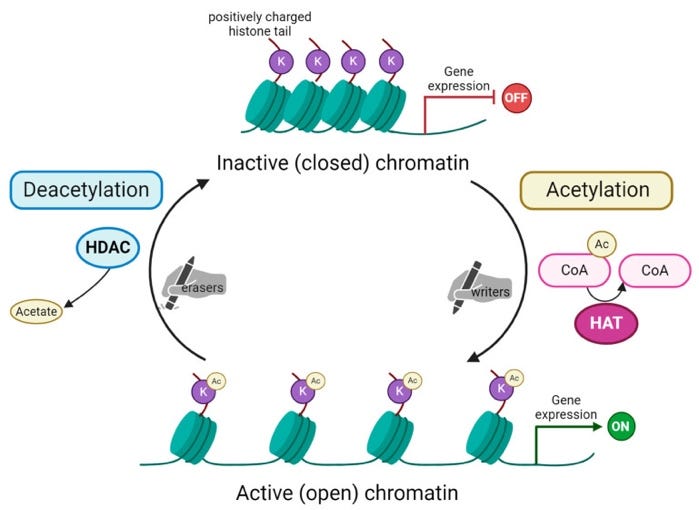
Epigenetics is a more complex topic than can be adequately described in a note of this length, but there are a few key items to understand in order to grasp Scribe’s approach. The typical cell contains enough DNA to stretch to five or six feet if fully unwound. This amount of DNA needs to fit within a cell’s nucleus, which poses somewhat of a challenge! Histones, small proteins that compact DNA, play a vital role in fitting everything within the nucleus. 8 histones and ~148 base pairs of DNA make a nucleosome, and these nucleosomes in turn make up chromatin. This chromatin can be divided into two types: heterochromatin and euchromatin. Heterochromatin refers to chromatin that’s tightly packed together, such that a cell’s transcriptional machinery is unable to access it. Euchromatin refers to chromatin that’s much more ‘loose’, in turn enabling transcriptional machinery access and, in turn, protein expression.
Again, this is an oversimplification, but whether chromatin is transcriptionally open or closed is affected in large part by histone acetylation, histone methylation, and DNA methylation. Histone acetylation (where an acetyl functional group is added to the lysine of a histone) leads to chromatin loosening, in turn enabling transcription. Histone deacetylation (where this acetyl group is removed) leads to chromatin tightening, in turn making transcription harder. Histone methylation (whereby methyl groups are added to specific histone residues) has a mixed result depending on the location: it can either open up chromatin (as it does when the 4th amino acid on histone 3 (H3K4) is methylated), or it can close it (as it does when the 27th amino acid on histone 3 (H3K27) is methylated). DNA methylation refers to the methylation of cytosines within a DNA sequence. This methylation often occurs at the promoter region of DNA, and, like histone deacetylation, leads to compacting of chromatin. Rather than causing a double-stranded break in the DNA, or swapping out one nucleotide for another, Scribe instead hopes to remodel a portion of chromatin from open to closed.
CRISPR-Cas has been previously leveraged in research settings to alter gene-expression, and you’ll see the CRISPRi and CRISPRoff tools come up often here. As with base-editing, the Cas nuclease is rendered catalytically inactive in these contexts (so no double-stranded break can be made), and the goal is instead to leverage the guideRNA to reach a desired portion of DNA. Once there, the aim is then to modify the histone and DNA methylation patterns at that location.
CRISPRi (or CRISPR interference) leverages a dCas9-KRAB fusion protein to solely modify histones. The KRAB-domain is typically a component of zinc-finger proteins, and recruits helper proteins to remove the three methyl groups from H3K4, in turn shifting chromatin from open to closed. The challenge with the CRISPRi approach is that the achieved gene expression changes are only temporary in nature. The same challenge was also found with the dCas9-DNMT3A-DNMT3L fusion protein. DNMT3A is an enzyme that methylates DNA rather than histones, again closing it off from transcriptional machinery; DNMT3L doesn’t methylate DNA itself, but rather serves as a supporting protein for DNMT3A. The promise of more permanent epigenetic editing came when dCas9, the KRAB-domain, DNMT3A, and DNMT3L were all fused together to form the CRISPRoff construct. This construct enables epigenetic changes to both histones and DNA, leading to more permanent modifications.
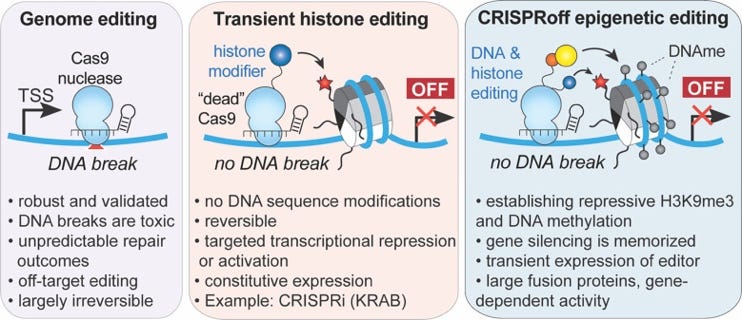
Unfortunately, CRISPRoff also has its problems. Only the catalytic portion of the DNMT3A enzyme is included in the editing tool, a change from how it exists endogenously. Within cells, the enzyme is allosterically regulated by the ADD domain. This ADD domain inhibits DNMT3A’s catalytic activity until it comes across unmethylated H3K4, an indication that this DNA is meant to be methylated and closed off from transcription. Without it, DNMT3A is liable to methylate, and so close off, portions of DNA that are meant to be transcribed. Aberrant methylation at off-target sites is exactly what occurs with CRISPRoff. In some cases, there’s enough aberrant methylation that it ends up significantly impairing cellular growth. While off-target methylation doesn’t result in an inadvertent change to the genome, it’s far from ideal. Aberrant methylation is a well-established cancer driver; Rett Syndrome and Fragile X syndrome are caused by genetic mutations, but the reason both are so damaging is because of how those mutations affect methylation.
Scribe has included this ADD domain in its CRISPR fusion protein, with the hope of reducing off-target methylation. The preclinical results were encouraging, with the ADD ‘proof-reading’ step dramatically decreasing off-target methylation while increasing methylation at the target site. Such a proof-reading step is especially important in a context, such as epigenome editing, where the Cas nuclease is intentionally rendered catalytically inactive. A standard CRISPR-Cas complex has some tolerance for binding to somewhat off-target DNA sequences, but will often detach from such a DNA target before making a double-stranded break.1 With a catalytically inactive Cas nuclease, however, this off-target binding is much more likely to result in activity at undesired locations. Put differently, CRISPR-approaches leveraging a catalytically inactive nuclease have a higher tendency for off-target issues anyway. ADD inclusion adds an extra guardrail to mitigate those off-target risks.
I find Scribe’s technology to be fascinating, but have a hard time getting comfortable with what potential uptake looks like. STX-1150’s NHP data showed LDL-C lowering of 51-68%. Although very good, this wouldn’t be sufficient lowering for the population not adequately managed on statins + ezetimibe + PCSK9 inhibitors. Nor for the population only adequately managed when on this triplet combo. Scribe couches STX-1150’s efficacy in terms of adherence-adjusted LDL-C lowering, a metric by which the candidate looks compelling:
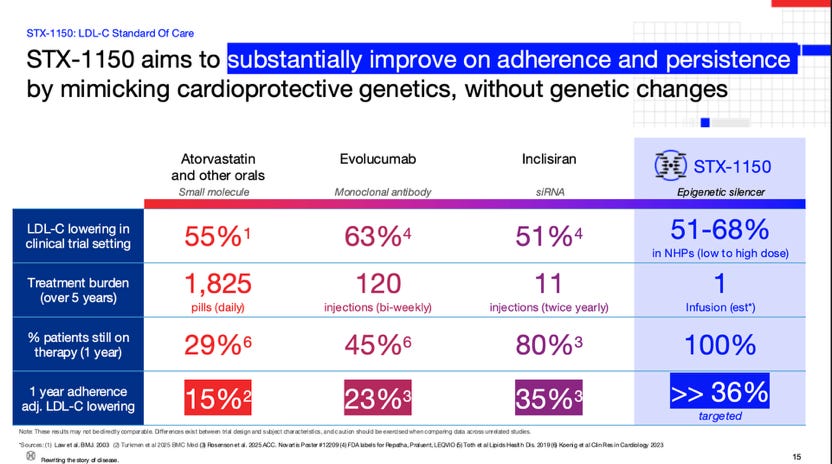
While important to solve patient adherence problems, the bottom line is STX-1150 still doesn’t get the most severe patients to goal. I think that’s a pretty critical drawback when the nature of the therapy is such that people are uncomfortable with it anyway. A one-time treatment that still requires I take statins and ezetimibe is not nearly exciting as one where I don’t have to take anything at all.2 STX-1150 carries a real convenience advantage, but that’s likely less of an attractive pitch when an experimental therapy is involved. Presumably part of why something like Otezla does over 2bn in sales despite more modest efficacy is because oral pills are exceptionally well-trodden paths.
The other question here is the degree to which off-target methylation is a more palatable risk than off-target genome editing. As mentioned above, aberrant methylation can have quite severe effects. Scribe argues any potential off-target methylation could be reversed, but I’m not sure we understand epigenome editing sufficiently to simply reverse it should things go wrong.
Disclaimer: The information in this post is not intended to be and does not constitute investment or financial advice. You should not make any decision based on the information presented without conducting independent due diligence.
There can still be off-target issues with approaches using an active nuclease, but those off-target effects are less than you would expect to see if you were looking solely at where CRISPR-Cas initially binds.
One could argue maybe the early-adopters are those only on statins and ezetimibe, but the challenge there is both medications are generic and those patients are clearly not in the sickest patient cohort. I think insurance approval would pose real issues there.