

I wrote last time on PROTACs, comparing them to traditional small molecules as well as covalent inhibitors. In short, a PROTAC is two small molecules connected by a linker. Small molecule A binds to the target protein, small molecule B binds to an E3 ligase. With well designed PROTACs, this in turn will cause ternary complex formation between the target protein, PROTAC, and E3 ligase. The E3 ligase then adds ubiquitin to the target protein, which acts as a flashing light to the proteasome that said protein needs to be degraded. As Derek Lowe put it, PROTACs are a way to “Make the entire target protein disappear from the cell.”
There are a few key points with PROTACs:
It’s a way to target ‘undruggable’ proteins. Traditional small molecules need to attach to a binding site that directly affects a protein’s function. If a protein doesn’t have a well-defined functional binding site you’re out of luck. PROTACs just need to bind to the protein in some way. Kymera’s STAT6 degrader for atopic dermatitis/asthma is a good example of this idea in practice: transcriptions factors are typically not reachable via traditional small molecules.
It enables you to affect a protein’s entire function, rather than only the function defined by its active site. We have Bruton Tyrosine Kinase inhibitors to inhibit BTK’s kinase function, but BTK also has a scaffolding function that we’re unable to target with standard approaches.
Binding affinity becomes less relevant. You need some amount of binding affinity between the PROTAC and target protein/E3 ligase, but more important is the strength of the protein-protein interactions between the target protein and ligase.
Like covalent drugs, there’s a decoupling of PK and PD. Once a target protein is degraded it remains out of commission until resynthesized. This is different from traditional small molecules, where once the drug exits the body the target is no longer inhibited.
PROTACs act catalytically, which is quite different from the occupancy-based model of traditional small molecules. Once a PROTAC degrades one protein, it goes and degrades another, and another, until it exits the cell. Standard small molecules don’t act this way. Once a traditional inhibitor separates from target protein A and instead inhibits target protein B, target protein A goes back to being active. In other words, PROTACs are one to many, traditional small molecules are one to one.
PROTACs have characteristics that violate standard Lipinski oral small molecule design rules. Namely, their molecular weight is too high, which in turn means their polar surface area is too high. There are different theories for why these drugs still seem to work (maybe the hydrogen bond donors/acceptors primarily associate with each other (and so are ‘hidden) when trying to cross a cell-membrane, maybe our traditional methods to calculate polar surface area actually miss a lot of nuance).
PROTACs get especially interesting on the brain-penetrant side, because of their potential utility and because they demonstrate how far we have to go on adequately understanding small molecule design. Their potential utility comes in on both the neurodegenerative side of things and cancer side of things. On the neurodegenerative front, a number of the proteins implicated in these diseases are very difficult to drug with traditional methods. Huntington’s Disease is caused by a buildup of exon 1 mHTT fragments and mHTT generally, but mHTT has historically been considered undruggable. α-Synuclein is a compelling target in Parkinson’s, but is intrinsically disordered (like c-MYC in the cancer context) and so, again, very hard to drug. There’s an accumulation of the tau protein in Alzheimer’s patients, but it’s also intrinsically disordered.
Theoretically, PROTACs should be a promising option for this disease class. As long as there’s a binding site (whether functional or not) these molecules can grab onto they should be able to affect all three of the above proteins. Importantly, PROTACs’ catalytic MoA means one doesn’t need that much drug to cross the blood-brain barrier. In short, PROTACs should be able to drug targets we know are implicated in neurodegenerative diseases and do so at lower concentration levels than a standard small molecule.
On the cancer front, there’s the potential for greater treatment efficacy through degrading the entirety of a cancer driving protein rather than only temporary inhibiting its kinase function. Brain-penetrant PROTACs also may demonstrate greater efficacy for those with cancers that have metastasized to the brain.
There is a wrinkle here, namely that PROTACs completely violate the standard rules that oral CNS-penetrant molecules are meant to follow. Pfizer developed a CNS Multi-Parameter Optimization tool with the following guidelines for an oral CNS-penetrant molecule:
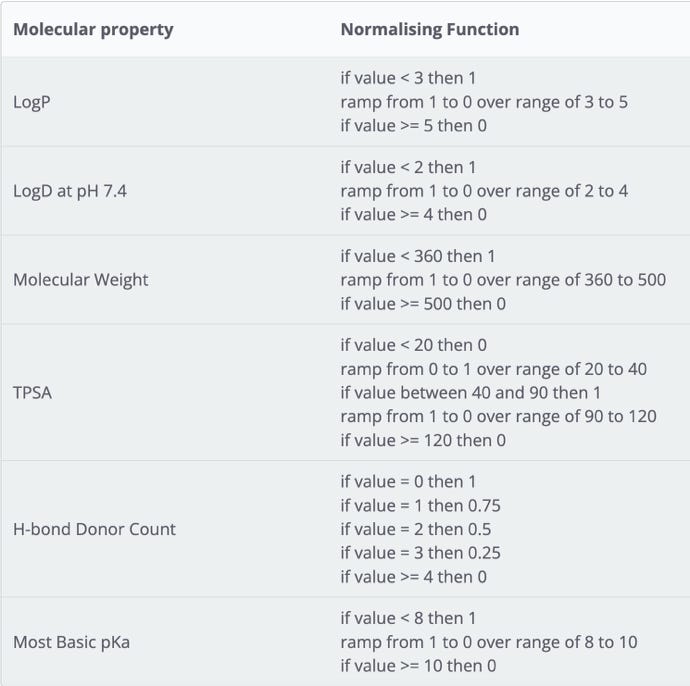
Each parameter gets a score of 0 to 1, and the numbers are then summed together. A value of 4 or above indicates the molecule will likely have good CNS-penetrance.
Without getting too bogged down in the weeds, these parameters are all trying to balance some amount of lipophilicity and polarity. In both cases, the requirements for CNS-penetrant small molecules are stricter than for their non-CNS penetrant counterparts. A molecule that’s too lipophilic risks getting stuck in the blood-brain barrier and failing to actually make it to the interstitial fluid; it will also have a tendency to get stuck in the body’s peripheral tissue, which then lowers the concentration of drug in the blood and means there’s less available to cross the blood-brain barrier in the first place.
The tighter requirements on the polarity side are largely due to the P-glycoprotein, an efflux protein present at the blood-brain barrier that binds to and pumps out substances it doesn’t think should be there. A more polar or larger molecule is exactly what the P-glycoprotein is on the lookout for. This efflux protein (and others like it) is a major constraint for designing blood-brain penetrant molecules. One now has to worry not only about minimizing polarity enough for a molecule to cross a membrane, one also has to minimize it enough to not be identified by efflux proteins.1
These MPO guidelines should mean that PROTACs are definitively out when it comes to CNS-penetrance. Here’s the MPO score for Nurix Therapeutics’ bexobrutideg (NX-5948), a BTK degrader:
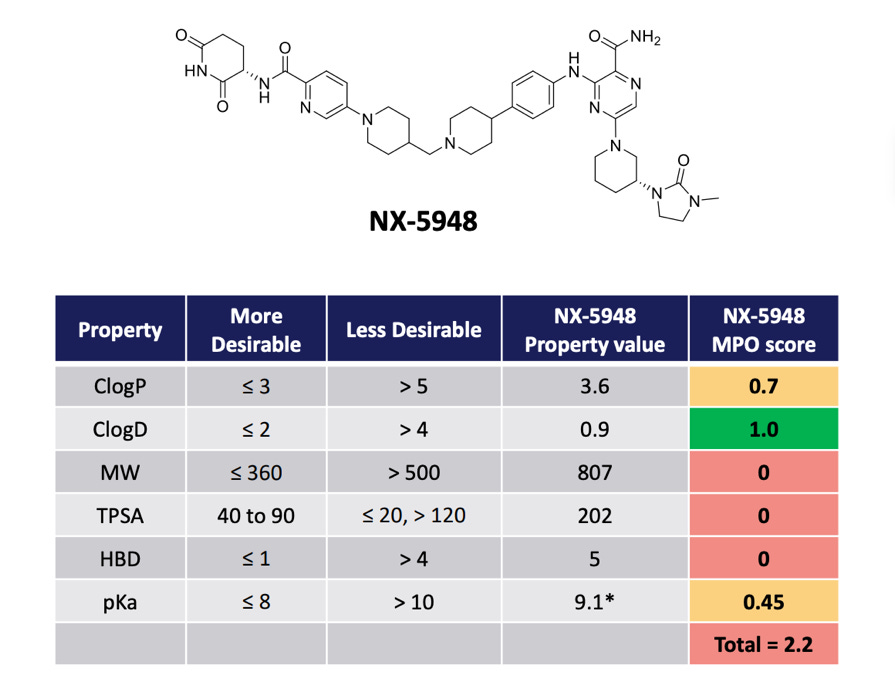
The MPO score is 2.2, well below what is needed for a molecule to cross the blood-brain barrier. NX-5948 is too heavy, has a polar surface area that’s too large, and has too many hydrogen bond donors. NX5-5948’s MPO is representative of PROTAC MPO scores generally: these molecules are just too large to satisfy CNS-penetrance requirements.
Despite all this, NX-5948 does have evidence of CNS exposure! As does Arvinas’ ARV-102 PROTAC in trials for Parkinson’s Disease and progressive supranuclear palsy, as does C4 Therapeutic’s CFT1946 PROTAC targeting the BRAFV600-mutant protein.2
This evidence of CNS exposure is fascinating. All that theory above is well and good, but it doesn’t offer much of an explanation for why PROTACs are an exception.3 To be clear, Lipinski’s Rule of 5 and Pfizer’s MPO score are just empirical observations, and aren’t meant to be hard and fast rules even if at times they’re presented that way. As I said in my previous PROTAC piece, we have FDA-approved beyond rule of 5 molecules that clearly work.
The nice thing about writing on CNS-penetrant PROTACs is very few have entered clinical trials, which makes generating an exhaustive list quite straightforward! Arvinas (ARVN) and Nurix (NRIX) each have CNS-penetrant candidates in clinical trials:
ARV-102 – in phase 1 trials for Parkinson’s Disease & progressive supranuclear palsy. ARV-102 targets LRRK2, a kinase/scaffolding protein implicated in both diseases. Denali/Biogen recently discontinued their own LRRK2 targeting Parkinson’s candidate after disappointing Phase 2b results that didn’t result in a slowing of disease progression, but this candidate only targeted LRRK2’s kinase function. DNL151 did demonstrate kinase inhibition of peripheral LRRK2, and showed a 30% reduction of phosphorylated Rab10 in cerebrospinal fluid (LRRK2 phosphorylates Rab10, so reduced phosphorylation should indicate LRRK2 activity is being inhibited). This could be viewed as having negative implications for ARV-102, but the hope would be that affecting the entirety of LRRK2 function, rather than just the kinase portion, should lead to a slowdown in Parkinson’s progression.
NX-5948 (bexobrutideg) – a BTK degrader in phase 3 trials as a 2L+ monotherapy for chronic lymphocytic leukemia (CLL). This is the same disease that Pharmacyclics covalent inhibitor, Ibrutinib, was developed for. NX-5498 is additionally in phase 2 trials for triple-exposed CLL, and being evaluated in non-Hodgkin’s Lymphoma. The company announced a partnership with Roche on NX-5948 in early June. A brain-penetrant BTK degrader is interesting for a few reasons. The first is that it’s a degrader rather than just an inhibitor, so potentially will be more effective at treating these blood cancers than existing options. The second is that it should be more effective for those with brain metastases (Ibrutinib/other BTK inhibitors for CLL do cross the blood-brain barrier, but they’re not engineered specifically to do so).4 The third is that BTK is implicated in multiple sclerosis, but you need sufficient quantities of your drug to enter the brain to potentially target the disease effectively. Sanofi has a BTK inhibitor, tolebrutinib, that was recently approved in Europe but rejected by the U.S. due to liver toxicity. Nurix is quick to point out they haven’t seen liver issues thus far, and the approach of degrading rather than only inhibiting BTK should, all else equal, drive better outcomes for MS patients.5
Disclaimer: The information in this post is not intended to be and does not constitute investment or financial advice. You should not make any decision based on the information presented without conducting independent due diligence.
Disclosure: I am long a small amount of Arvinas. Cool science, broad pipeline, trades below cash.
There’s a large amount of overlap between molecules that have good passive diffusion and molecules that won’t be identified by P-gp, and so a lot of journal articles on blood-brain penetrance will emphasize improving the former. It’s worth highlighting that this emphasis is because a molecule with better passive diffusion qualities will do a better job at evading efflux proteins. I say that because at times one could come away from some of these CNS-penetrant journal articles thinking that non-CNS penetrant molecules don’t need good passive permeability: that’s absolutely not the case.
C4 has paused developed for CFT1946 until they can find a partner
This paper is very interesting and theorizes that the CD36 membrane protein is responsible for helping PROTACs (whether CNS-penetrant or not) enter cells.
CLL doesn’t often metastasize to the brain, but such a phenomenon is common in other cancers like NSCLC (hence GSK’s 10bn acquisition of Nuvalent!)