

Molecular glues, or small molecules that affect the interactions between two proteins, have gotten a lot of press recently. This is thanks to the FDA’s recent approval of RevMed’s Daraxonrasib for metastatic pancreatic cancer. Daraxonrasib enters the cell, binds to a protein called Cyp(A), and then forms a tri-complex with RAS(ON), a well-known cancer driver1 This tri-complex prevents RAS(ON) from performing its typical downstream functions, resulting in a ~doubling of PFS in metastatic PDAC patients compared to the standard of care. While Daraxonrasib acts as an inhibitor, that’s not the only way to leverage molecular glues. They can also be used, like PROTACs, as protein degraders.
PROTACs (in both their CNS-penetrant and non CNS-penetrant forms) are exciting chiefly because they offer a way to hit previously undruggable targets (as Kymera’s KT-621 does with STAT6), they act catalytically (degrade one target protein, then another, then another) and degrade entire proteins rather than only inhibit an active site. From a more academic perspective, PROTACs are fascinating because they don’t follow the typical design rules of thumb for oral small molecules, and because there’s this PK/PD decoupling that one doesn’t typically see in non-covalent oral drugs.
Molecular glues can similarly leverage a cell’s pre-existing protein degradation system. Both degrader types act catalytically, and both aim to encourage interactions between an E3 ligase and a protein of interest. The E3 ligase ubiquitinates the POI, which serves as a blinking light for the 26S proteosome, which then comes along and breaks the protein into its amino acid components. In the case of PROTACs, you really have two small molecules joined together by a linker. One small molecule binds to the target protein, one to an E3 ligase, and the hope is that this encourages ternary complex formation between the PROTAC, POI, and ligase. Molecular glue degraders are a bit different. They’re truly one small molecule, and bind to either the E3 ligase or POI, in turn altering said protein’s shape. The goal is to alter the surface enough to encourage novel protein-protein interactions between the ligase and protein of interest. The protein will then be ubiquitinated and subsequently degraded. A protein of interest that’s now able to interact with an E3 ligase is termed a ‘neosubstrate.’
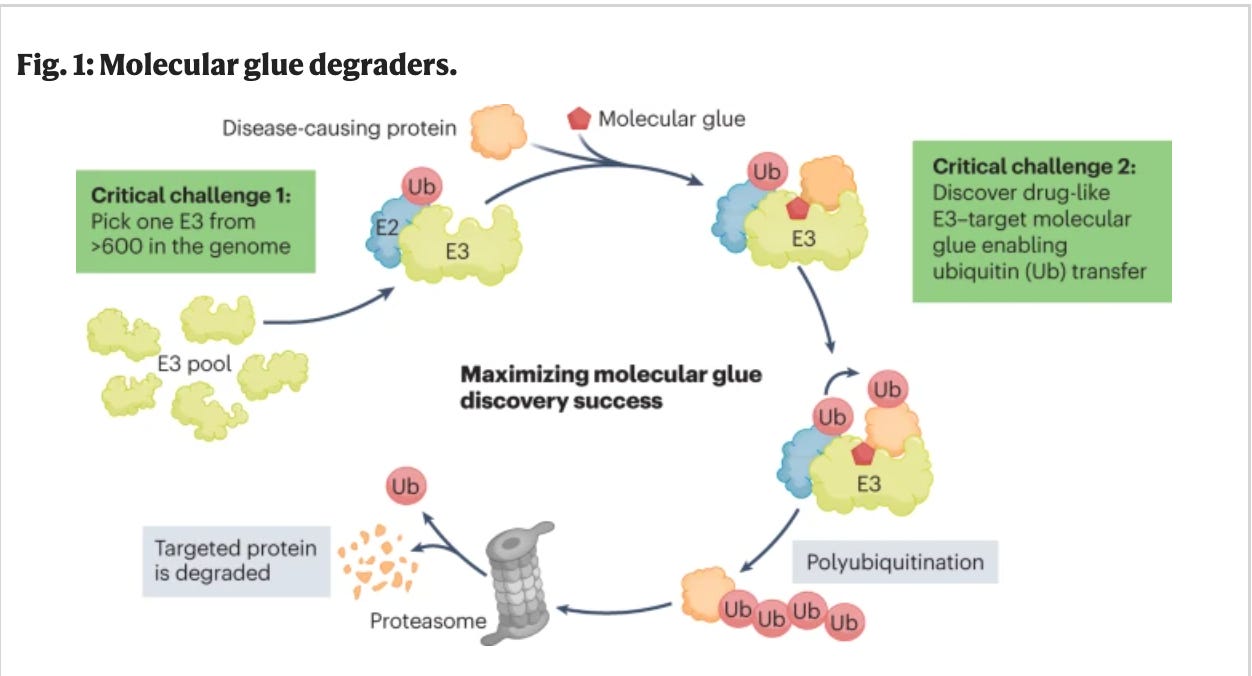
When it comes to treating diseases, the PROTAC/MGD modalities offer the following advantages:
1) They’re small molecules rather than biologics. Kymera gets a valuation bump compared to other clinical-trial stage AD companies because KT-621 could offer Dupixent like efficacy but in oral form. Patients may not care that KT-621 is targeting a historically undruggable transcription factor, but likely do care that it doesn’t require subcutaneous administration. Theoretically, KT-621 would be preferred by new atopic dermatitis patients and the pre-diagnosed patient pool that doesn’t want to deal with an injection. This oral preference is why Lilly has put so much effort into oral GLP-1s, and why investors are excited about Protagonist Therapeutics’ oral IL-23 inhibitor (Why take Skyrizi when you can take an oral option?)2 You’ll see a lot of PROTAC/MGD companies working on I&I drugs, in part because biologics have had so much success here: an oral form could mimic that success and then some (Otezla’s done very well in plaque psoriasis even with subpar efficacy).
2) They’re promising ways to target undruggable proteins that we know are disease drivers. This especially comes up in the cancer context, where there are proteins we’ve known to be cancer drivers for decades but have been unable to target. Daraxonrasib, while not a degrader, is the perfect illustration of this: it’s targeting a protein known to be a cancer driver in a cancer type with a very poor prognosis. The commercial consequence is peak sales estimates of ~10bn. You’ll see similar cancer efforts across degradation companies: Arvinas with BCL6 in non-hodgkin lymphoma, Monte Rosa with GSPT1 in castration-resistant prostate cancer, and Foghorn with ARID1B across a range of cancers. Like I&I, the oral component holds importance here: particularly in metastatic contexts, not having to go to a clinic/hospital for treatment really improves quality of life (this is why the bar for Celcuity’s drug in mutant PIK3CA breast cancers was high: patients would rather avoid coming in for weekly infusions even if their progression-free survival might suffer).
3) Again on the cancer side, they’re a way to get around mutations that render kinase inhibitors ineffective, or to get around side-effects caused by off-target kinase activity. Allosteric avenues pursued by companies like Terns or Relay are exciting for the same reason. These approaches are so attractive because we already know the previous kinase inhibitors work/are commercially viable, and so it just becomes a question of engineering something better. Triana Biomedicines is doing some work here on the ALK positive non-small cell lung cancer front (there’s a particular need on the brain-penetrant ALK-positive side of things, as evidenced by GSK’s recent ~10bn acquisition of Nuvalent. Nuvalent’s neladalkib isn’t a degrader, but this paper is a fascinating read on the molecule’s promise).
4) They’re potentially interesting avenues for tackling neurodegenerative diseases. LRRK appears to be implicated in Parkinson’s Disease, but thus far kinase-targeting approaches like Biogen/Denali’s haven’t shown much promise. It could be that we need to degrade the protein in its entirety, and PROTACs/molecular glue degraders are an effective way to do that.
There are some differences between PROTACs and MGDs:
1) Because MGDs are one small molecule, they do tend to follow standard rule of 5 small molecule design rules. (Candidly, I find them somewhat less interesting than PROTACs because of this).
2) MGDs do not exhibit a hook-effect. With PROTACs, efficacy can decay as dosing goes higher. This occurs because, again, PROTACs are really two small molecules. At high doses the drug ends up crowding itself out: a number of the bifunctional molecules bind to the POI, a number bind to the E3 ligase, and there ends up not being sufficient unbinded POIs/E3 ligases around to actually form ternary complexes.
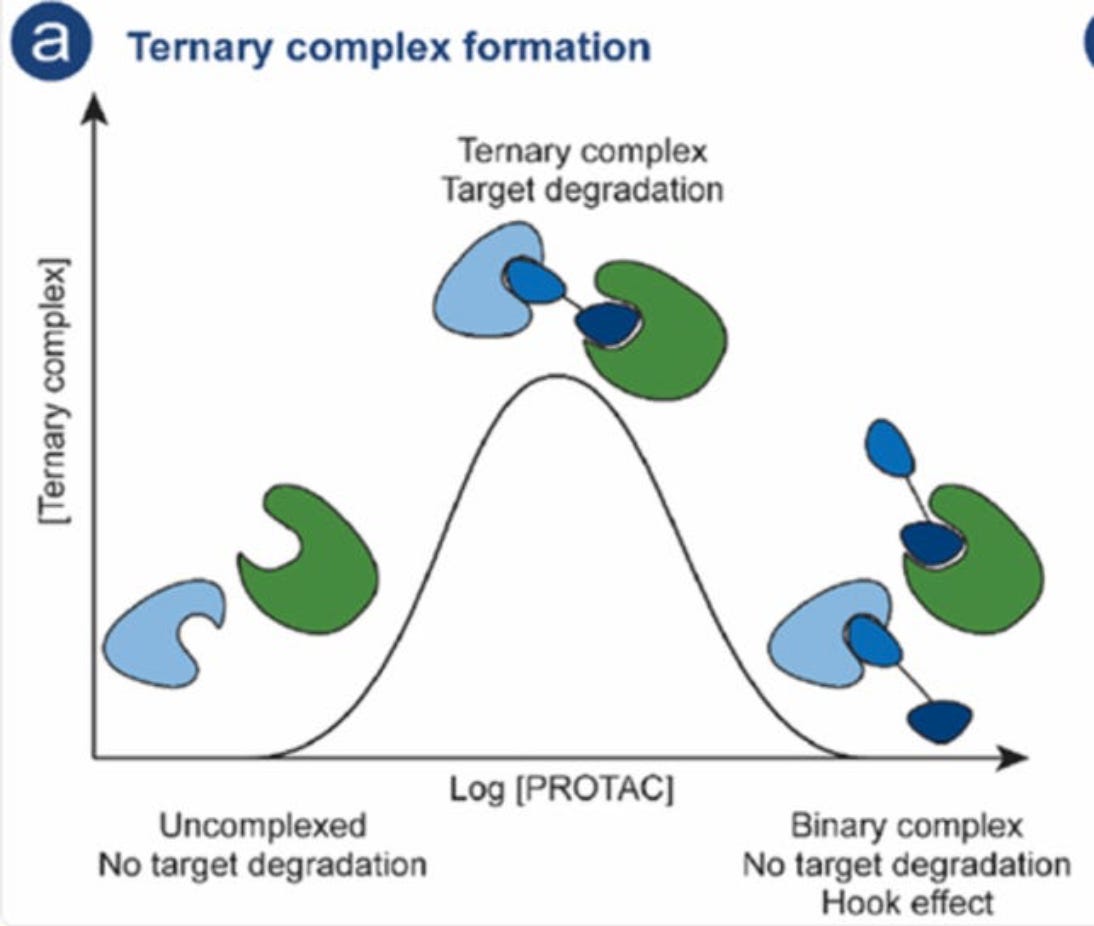
3) MGDs are harder to intentionally design.
Point (3) requires additional explanation, partly because it’s held back how investable the modality is. PROTACS have always been rationally designed. One finds a molecule that attaches to a binding site on the target protein, a molecule that attaches to a binding site on the E3 ligase, then joins these molecules together to see if a ternary complex between the PROTAC, E3 ligase, and POI results. MGDs, however, have historically been discovered accidentally. Both molecular glues and molecular glue degraders have also historically been FDA approved before we understood these molecules’ actual mechanism of action (Cyclosporin A has been approved in the organ-transplant context since the early ‘80s; we didn’t know it was a molecular glue until the early ’90s).
In the case of PROTACs, developers leverage current knowledge on target protein/E3 ligase structure and any respective binding pockets. For molecular glue degraders, this isn’t helpful. For one, molecular glue degraders aren’t trying to take advantage of binding pockets, whether functional or otherwise.3 Moreover, the protein-protein interactions that occur as a result of the molecular glue occur only because the molecular glue has altered the surface of either the E3 ligase or POI. These degraders are useful because they alter the E3 ligase/POI structure; a study of those structures beforehand is largely only going to reveal that the E3 ligase/POI structures don’t lend themselves to favorable PPIs, which is exactly why the molecular glue is being designed in the first place!
Our understanding of how MGDs operate is improving, and there is now some progress being made on the rational design front. The role of degrons is an essential part of this improved understanding, and best illustrated through the example of thalidomide and its analogues, MGDs used to treat multiple myeloma (this class of drugs is referred to as immunomodulatory drugs, or IMiDs).
While thalidomide was approved to treat multiple myeloma in 2006, its function wasn’t adequately understood until eight years later. The drug is a molecular glue degrader, and successfully degrades IKZF1/IKZF3, transcription factors that are very challenging to drug with traditional small molecule approaches. Thalidomide first binds to cereblon, a part of theCRL4CRBN E3 ligase complex. This binding alters the cereblon surface, and in turn leads to tri-complex formation with cereblon, thalidomide, and IKZF1/IKZF3.
A thalidomide analogue, lenalidomide, was also found to degrade CK1α and GSPT1, two other cancer drivers. This finding was puzzling, as there aren’t obvious structural similarities between IKZF1/3, CK1α, and GSPT1. (Unlike, say, the clear similarities that are present between different kinases, hence the off-target effects of kinase inhibitors).
It turned out the above proteins did share an important characteristic: they all contained the same degron (in this case, what’s referred to as the G-loop degron). Degrons are short amino acid sequences or structural motifs on a protein that facilitate interactions between said protein and an E3 ligase. In other words, they’re a key part of an E3 ligase recognizing that a protein needs to be tagged for degradation. Degrons are not the only thing required for favorable PPIs to occur, but they explain why cereblon plus a molecular glue led to interactions with a diverse set of proteins: once cereblon was slightly modified it was in a position to take advantage of that degron.
This knowledge is incredibly useful, because it’s an effective way to then try and find proteins that could be degraded via molecular glue. Once you find a degron that an E3 ligase recognizes, you can then screen proteins for the presence of that degron (or something very similar to that degron) on their solvent-exposed surfaces. Now you have a list of proteins that could be degraded by that E3 ligase, and can then screen for adequate ternary complex formation.
Our evolving knowledge here means that it’s now possible to back MGD platforms, such as Monte Rosa and Triana Biomedicines. This paper from Monte Rosa is a good illustration of what these platform-based companies are aiming to do. Monte Rosa researchers screened the structural proteome for ‘surface-exposed G-loop like motifs’ (or, in other words, a structure that looks like the G-loop degron and is in a position to interact with an E3 ligase. It’s no good having a G-loop degron that’s not solvent exposed!). The results were compelling:
“The predicted G-loops are distributed over >250 domain types and nearly 100 different target classes, many new to this modality and currently perceived as inaccessible to small-molecule ligands.”
Put differently, they found a number of targets we can’t drug with standard small molecules and didn’t know were potentially druggable with MGDs. Interestingly, Monte Rosa went a step beyond screening only for proteins with degron mimics. Its researchers ran a second screen for proteins whose molecular surfaces actually were quite similar to a protein IMiDs were helping to degrade. CK1α, IKZF1/IKZF3, and GSPT1 may be structurally different from one another, but in theory a protein with a similar molecular surface to, say, CK1α should be in a position to form favorable hydrogen bonds with cereblon. This was indeed the case for VAV1, a protein implicated in autoimmune disease and cancer that lacks an obvious druggable pocket. While VAV1 did not appear to have a surface-exposed G-loop, it did have a molecular surface similar to GSPT1, and demonstrated an ability to form a tri-complex with cereblon and an MGD.
Disclaimer: The information in this post is not intended to be and does not constitute investment or financial advice. You should not make any decision based on the information presented without conducting independent due diligence.
RAS can exist in its GTP-bound (ON) or GDP-bound (OFF) state. The issue with mutated RAS is it remains chronically stuck in the (ON) position.
This oral vs injection preference is a matter of some debate. It could be that if an injection is infrequent enough patients prefer that to a daily pill. Watching whether the launch of Merck’s enlicitide (oral pill) affects growth of Novartis’ inclisiran (twice yearly injectable, although given by a physician) in the PCSK9 inhibitor space will be one imperfect way to watch this debate play out.
Monte Rosa tries to argue PROTACs aren’t truly targeting undruggable proteins because of this binding pocket requirement. That’s not really true: traditional small molecules need to bind to a functional pocket to have an effect. PROTACs just need to bind to some sort of pocket, whether functional or otherwise.