

There’s been a large amount of progress made targeting RAS, a known cancer driver historically considered undruggable, over the past few years. Things kicked off with Sotorasib and Adagrasib, covalent inhibitors targeting the KRAS G12C mutation. These drugs represent a step forward in hitting a challenging target (and show the promise of chemoproteomics), but are relatively limited in scope. There are mutations beyond KRAS G12C, and not all these mutations are good candidates for covalent drugs (what made G12C an attractive covalent target is cysteine’s nucleophilicity). Moreover, a mutation-by-mutation approach isn’t ideal: getting drugs approved one mutation at a time means one is constrained to helping only one subset of RAS-mutated patients at a time. Sotorasib/Adargrasibs’ limitations explain the excitement around Revolution Medicines’ Daraxonrasib: it’s a molecular glue that acts as a pan-RAS inhibitor, and so is able to help RAS-mutated patients regardless of the specific mutation they may have.1
Unfortunately, there’s been much less progress made when it comes to targeting p53, another protein whose mutations have been known for decades to contribute to cancer growth. Like RAS, p53 has been frustratingly undruggable. p53 is a transcription factor, and is often referred to as the “Guardian of the Genome.” It has a multiplicity of functions (and likely does a lot that we don’t yet understand), but most importantly for this context acts as a tumor suppressor:
“In response to cellular stress, p53 prevents the differentiation of cells with mutated or damaged DNA and terminates cellular processes by transcriptionally activating various genes involved in apoptosis and cell cycle, which contributes significantly to its tumor suppressor function” – Source
Put differently, p53 stops cancerous cells/cells with the potential to be cancerous from dividing. Mutant p53, however, can’t nip those cancerous cells in the bud. It’s little surprise, then, that p53 is the most frequently mutated gene found in cancers.
p53 mutations are different in their effects than mutations in cancer drivers like RAS and c-MYC. In those cases, the problematic mutations lead to protein overexpression. RAS stays chronically stuck in the on position, so cells enjoy unchecked growth. Similarly, c-MYC mutations lead to c-MYC overexpression, which in turn leads to upregulation of genes that drive cell division/proliferation. p53 mutations, on the other hand, result in too little p53 expression. Elevated p53 levels is exactly what one wants in cancerous cells.
Consequently, when it comes to p53 targeting there are interesting avenues for cancer patients with mutated p53 and for those with wild-type p53. On the mutated side, the goal is to restore p53 to its typical function and in turn (hopefully) kill off cancerous cells. On the wild-type p53 side, the goal is to upregulate p53 and get it to do more of what it’s already doing. P53 expression levels are typically kept in check by MDM2/MDMX, which ubiquitinate p53 and so target it for degradation (this ubiquitination process is exactly what PROTACs try to take advantage of). Interestingly, MDM2 is often found to be upregulated in cancerous cells, and so therapeutic attempts for wild-type p53 patients often focus on inhibiting the protein-protein interactions between MDM2/MDMX and p53.)
We haven’t yet had much luck on either the mutated or wild-type p53 front. Attempts to upregulate healthy p53 is a subject for another time, but I’ll note that there have been multiple attempts to inhibit that MDM2/MDMX-p53 interaction without much success. Kymera had an interesting PROTAC, KT-253, that aimed to degrade MDM2, but put it on the back burner in favor of its I&I candidates.
The challenge with targeting mutant p53 comes down to two factors:
1) It’s a transcription factor, and like most transcription factors doesn’t have obvious binding pockets. One avenue that’s shown promise with targeting TFs is PROTACs (see KT-621 or Arvinas’ vepdegestrant), but that won’t work for mutant p53! Mutant p53 is under expressed rather than overexpressed; targeting it for degradation takes expression levels in the opposite direction from desired.
2) There’s a massive number of p53 mutations (over 25,000 according to PMV Pharma’s S1). This is in pretty stark contrast to RAS mutations where there are ~150, and only five responsible for ~70% of RAS-mutant patients. p53 mutations are not only numerous, but there also aren’t clearly dominant ones:
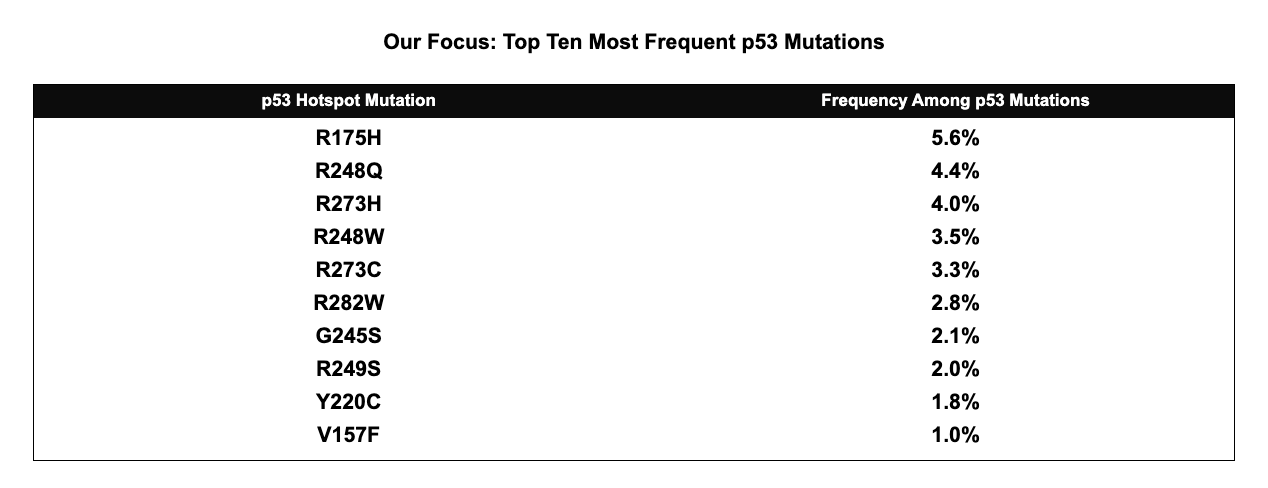
So p53’s not only conventionally undruggable, but its most dominant mutation only shows up in ~5.6% of solid tumors.
Given the above, there’s not a > 40 billion market cap Revolution Medicines-equivalent company in the p53 space. There’s instead PMV Pharma (which trades sub its cash balance), Frontier Medicines (which has a p53 candidate but is a chemoproteomics company more than a p53 one), and a few Chinese companies with p53 candidates in the pipeline.
PMV Pharma is a good illustration of why trying to build a p53 platform is so challenging. It went public in late 2020, and at that time described itself as “a precision oncology company pioneering the discovery and development of small molecule, tumor-agnostic therapies targeting p53 mutations.”2 The company’s lead asset targeted the Y220C mutation, but the plan was to branch out beyond that and target other p53 mutants.
Things unfortunately did not go to plan. The biopharma funding market dried up, and so management had to cut two earlier stage candidates to preserve cash. To compound misfortune, rezatapopt didn’t end up working well in patients with both a p53 Y220C mutation and a RAS mutation. That’s a bit of a problem! There was some hope that rezatapopt could be combined with an immunotherapy like Keytruda, but the combination study was halted in phase 1 due to dose-limiting toxicities.
It’s not totally hopeless for the company. Y220C mutations are present in 3% of ovarian cancers, a cancer type with a very low frequency of RAS mutations. There’s also a high unmet need here: we unfortunately don’t have much to offer ovarian cancer patients once they become resistant to platinum-based chemotherapy. There are a number of antibody-drug conjugates for ovarian cancer in clinical trials, but many of them use the same toxic payload, so it’s unlikely a patient cycles from one ADC to the other. Corcept Therapeutics’ ($CORT) relacorilant was recently approved, but it’s far from a cure (median PFS was 6.5 months compared to nab-paclitaxel’s 5.5 months, median OS was 16 months compared to nab-paclitaxel’s 11.9 months).
Rezatapopt’s phase 2 data for heavily-pretreated ovarian cancer patients was quite promising, with an ORR of 44.4%. The study didn’t require patients to be platinum-resistant or refractory, but data was importantly good for both of those cohorts (ORRs of 45.5% and 44%, respectively). Median duration of response was 8.2 months for the cohort, which is quite a strong number compared to relacorilant’s 5.6 months in its phase 2 trial (yes, standard caveat on the difficulty of cross-trial comparisons). Importantly, rezatapopt is administered orally and unlike relacorilant was not used in conjunction with chemotherapy. A non-chemo approach is a meaningful quality of life improvement for a patient group that’s already very sick.
PMV management plans to file for approval for platinum-resistant/refractory ovarian cancer patients based on this phase 2 data in Q127. I hope patients who stand to benefit from rezatapopt will be able to get it, but would flag that management’s US peak sales estimates are on the optimistic side at 350mm-420mm. That’s based on 900 eligible ovarian cancer patients every year. The eligible population sizing is reasonable enough, but at the midpoint of peak sales that means revenue per patient of ~427k. Median time to response and median duration of response from phase 1/2 data were 1.3 months and 8.2 months, respectively. Those numbers are both calculated only in treatment responders, so the average patient is highly unlikely to be staying on rezatapopt for even 9 months. I would put the odds of reza being priced in the ~47k a month range as quite low. While I don’t necessarily disagree with how PMV sizes the US market, it’s worth pointing out that biomarker testing usage is lower than we’d hope it would be; that will impact the number of patients who even realize they’re eligible for PMV’s drug. Even with 100% penetration, if you assume a price point of 30k a month and the average patient staying on reza for 7 months that puts the peak sales number more the in ~190mm range. To further complicate matters, the company only has cash to get through Q227. The cash raise will need to support more than commercialization efforts: the phase 2 is still ongoing in various solid tumor types, and a confirmatory phase 3 study will have to be run in support of Reza’s accelerated approval.
The other, more philosophical, point I’d make is that PMV’s candidate doesn’t represent a true step forward in figuring out p53 druggability. The mutation reza targets, Y220C, creates a hydrophobic pocket in the transcription factor, and so makes it amenable to traditional small molecule approaches. Reza fits into that pocket, and in so doing restores p53 to its original, wild-type, form. This isn’t an attempt to disparage the molecule, only to point out the drug doesn’t represent some new frontier in drugging transcription factors.
Disclaimer: The information in this post is not intended to be and does not constitute investment or financial advice. You should not make any decision based on the information presented without conducting independent due diligence.
The downside is that Daraxonrasib also inhibits wild-type RAS, which is why Ben Sasse can be seen with facial wounds in some interviews
PMV Pharma S1, pg 116.